
Keyword cannibalization may appear to be a problem for SEO archaeologists, but in reality, it is a struggle that practically any website that is expanding faces in the present day. As your content collection grows, it will become increasingly simple for many sites to mistakenly target the same keyword through the use of the same term. Consequently, this results in confusion, not just for Google but also for its users.
How would you feel if you had three distinct blog posts contending for the title of “best SEO practices”? Instead of increasing the authority of your domain, you are making it less powerful. When these pages compete with one another, they reduce the ranking potential of each other, which ultimately leads to a decrease in visibility for all of them. This is where the cannibalisation of keywords originates from.
With the help of this article, you will learn exactly what Keyword cannibalization is, how to recognise it in your content ecosystem, how to remedy it without negatively impacting your results, and most crucially, how to avoid it in the future.
What exactly is meant by the term “cannibalisation”?
Keyword cannibalization occurs when many pages on your website compete for the same keyword or topic, thereby hurting each other’s success in search rankings. This can happen when you have multiple pages on your website.
Let’s look at an extreme case. Imagine an online store that has three distinct sites that are optimised for the term “best running shoes”: a blog post, a page that lists the categories of products, and a buying guide. Search engines might not be able to determine which of them should be prioritised if they are all competing for the same keyword, which would result in none of them ranking well.
In most cases, this problem is caused by:
- Combining different content strategies
- Poor planning of keywords
- Posts from the past that have not been taken down or merged
- Miscommunication between content teams
Some examples of overlap are strategic, such as targeting numerous long-tail variations of a core phrase. Keyword cannibalization is not necessarily a negative thing; there are deliberate cases of overlap. However, it is time to take action if you observe a decline in ranks, inconsistent impressions, or sites that are competing with yours.
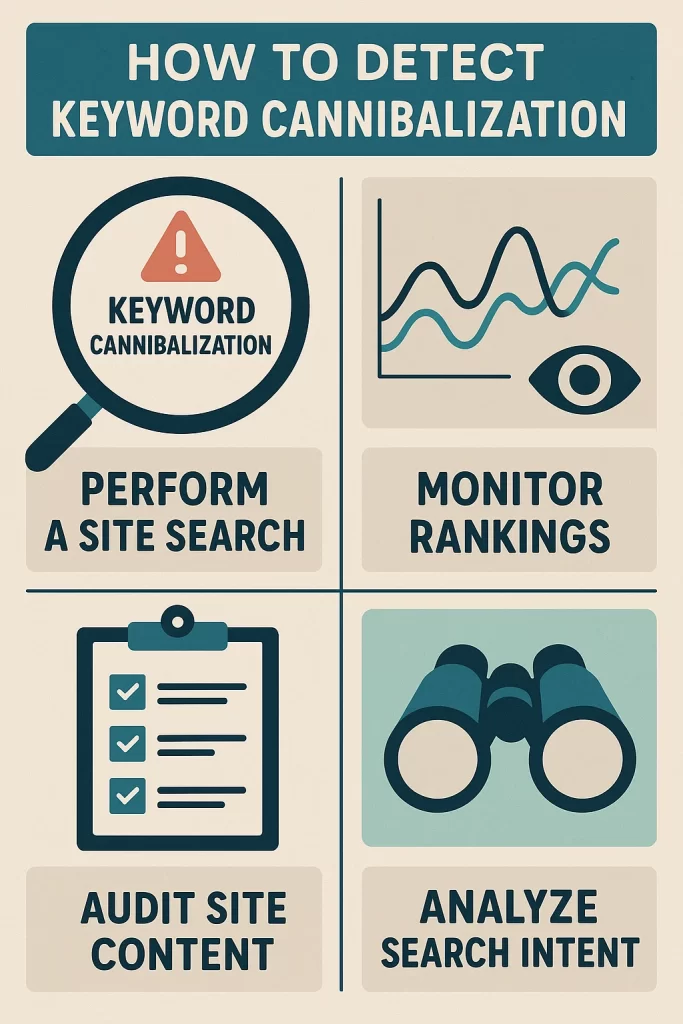
How to Identify Cannibalisation of Keywords
Step 1: Utilising the Google Search Operator
Make use of the query:
www.yourdomain.com website “your keyword”
All indexed pages that are relevant to the term will be displayed here. There is a high probability of cannibalisation occurring when you observe multiple blog articles or category pages ranking for the same keyword.
Step 2: Google Search Console is the second method.
Proceed to the report that says “Performance.”
Utilise a specific keyword as a filter.
Make sure to check the “Pages” tab; if more than one page is receiving impressions for the same query, it is possible that they are competing with one another.
Step 3: Search Engine Optimisation Tools
Ahrefs, SEMrush, and Screaming Frog are examples of applications that offer tools for identifying instances of keyword overlap:
- Checking organic keywords and filtering by term can be done with the help of Ahrefs’ Site Explorer.
- Make use of the “Position Tracking” or “SEO Content Template” features that are available in SEMrush
- Using Screaming Frog, you can map out the usage of keywords throughout the architecture of your website.
Where to Look Pages that have meta names or descriptions that are identical to one another
- Decreases in the amount of click-through rates or traffic
- SERP ranks for essential pages that are constantly shifting
- A large number of blog entries that are nearly identical or duplicate material
How to Avoid Cannibalisation of Keywords
1. Consolidate Your Content
When competing pages are combined, the result is a single, authoritative resource. The secondary pages should then be redirected using a 301 redirect. Search engines are instructed to direct link equity to the primary page as a result of this.
2. Refine Search Intent
If you have two pages that are both titled “best skincare routine,” you should make sure that one of them is geared towards novice users and the other is geared towards more experienced users. Differentiating purpose helps to improve user experience and prevent confusion.
3. Canonical Tags
If you really must preserve both pages, you should assign a canonical tag to the weaker one that will direct you to the stronger one. In this manner, search engines will give priority to the version that you choose.
4. Improve Internal Linking
You can improve the hierarchy of your website by utilising targeted anchor text to connect back to content that is considered to be pillars. By way of illustration, every single blog post that discusses “on-page SEO” ought to connect to your primary SEO guide.
5. Prune or Noindex
If you have pages that are not functioning well or that are out of date and do not provide any genuine value, you should think about pruning them or utilising noindex tags to remove them from the sight of search engines.
Also Read: What strategies can I implement to fix keyword cannibalization?
Strategies to Avoid Keyword Cannibalisation
1. Keyword Mapping
Each and every term belongs on its own page. Before beginning to write any content, you should first assign one target term to each page by using keyword mapping tools or a straightforward spreadsheet.
2. Conduct Content Audits
Establish a reminder to review your content every three months or every six months. Find posts that are no longer relevant, overlap with other posts, or are not doing well, and then determine whether to merge, update, or retire them.
3. Use Pillar and Cluster Strategy
Create topic clusters by grouping material that is related to itself. To illustrate, you could make a pillar page on the subject of “SEO,” and then write subtopics such as “technical SEO,” “on-page SEO,” and “SEO tools” that connect back to the main page.
4. Set Editorial Guidelines
Ensure that your content staff is familiar with the keyword mapping method you have implemented. It is important to make use of style guides in order to specify target keywords, internal linking techniques, and policies regarding keyword variety.
5. Monitor Regularly
For monitoring the movement of keywords and the performance of pages, you can make use of paid platforms or tools such as Google Search Console. You can set up alerts to notify you of rank declines or URLs that overlap.
Case Studies and Results
On the subject of “best practices for remote work,” one technology startup published five blog entries, each of which was produced over the course of two years. None of them managed to make it past page two. Following the consolidation of these posts into a single definitive post and the redirection of the others, rankings jumped to the second position within forty-eight days. The following month saw a 47% increase in the amount of traffic.
In order to identify potential overlaps early on in the content development process, another e-commerce business utilised keyword mapping. Within a period of six months, they were able to reduce instances of cannibalisation by eighty percent and boost organic traffic for category pages by sixty percent.
The conclusion
Keyword cannibalization is a prevalent practice in search engine optimisation (SEO) that can be remedied and can stealthily erode your ranks. Self-competition may be eliminated and your content can be given the best possible opportunity of being successful if you conduct thorough audits, carefully plan, and use the appropriate tools. Take the time to conduct a keyword audit if you haven’t done so already; your traffic will be grateful to you for doing so.